
Drs. Wes Williams and Landon Mackey once again found themselves on the Outer Banks this summer. Their appearance in July was punctuated by another successful deployment and recovery of their wave-powered desalination device.
The Wave-Actuated, Tethered Emergency Response Buoyant Reverse Osmosis System, fondly referred to as WATER BROS, was first designed roughly six years ago by the pair for the U.S. Department of Energy’s Waves to Water Prize. The competition tasked competitors with creating a small-scale, mobile desalination unit that could be powered by ocean waves in disaster relief and recovery scenarios. Williams and Mackey’s success through the various phases of the competition eventually landed the Water Bros team and their device on Jennette’s Pier for the 2021 DRINK Finale. While the WATER BROS prototype did not win the grand prize, Williams and Mackey were not deterred. They have since garnered additional funding from the U.S. Department of Energy and continue to make waves with further iterations of their marine energy device.
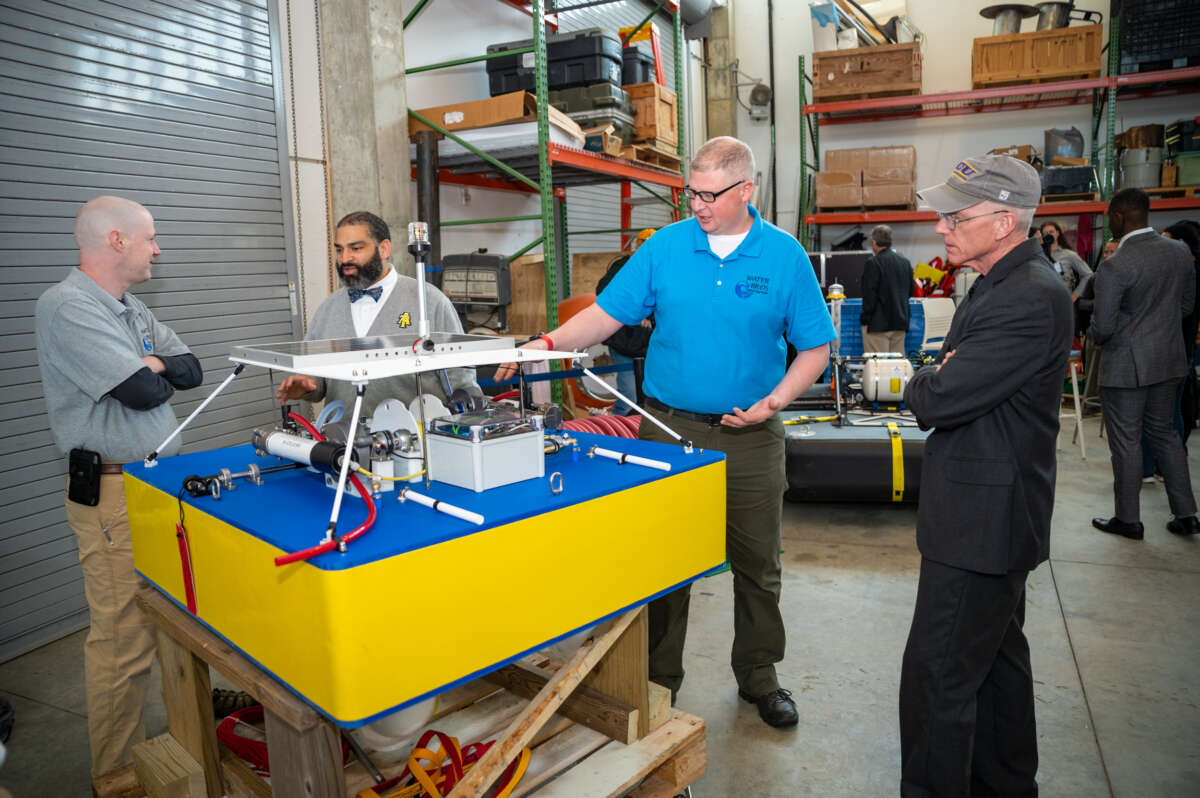
Drs. Wes Williams and Landon Mackey once again found themselves on the Outer Banks this summer. Their appearance in July was punctuated by another successful deployment and recovery of their wave-powered desalination device.
The Wave-Actuated, Tethered Emergency Response Buoyant Reverse Osmosis System, fondly referred to as WATER BROS, was first designed roughly six years ago by the pair for the U.S. Department of Energy’s Waves to Water Prize. The competition tasked competitors with creating a small-scale, mobile desalination unit that could be powered by ocean waves in disaster relief and recovery scenarios. Williams and Mackey’s success through the various phases of the competition eventually landed the Water Bros team and their device on Jennette’s Pier for the 2021 DRINK Finale. While the WATER BROS prototype did not win the grand prize, Williams and Mackey were not deterred. They have since garnered additional funding from the U.S. Department of Energy and continue to make waves with further iterations of their marine energy device.
For faculty and staff at the Coastal Studies Institute, the WATER BROS team’s growing success in the last several years has been particularly exciting. Both Mackey and Williams have roots within the NC Renewable Ocean Energy Program (NCROEP). Williams is a professor of mechanical engineering technology at UNC-Charlotte, an NCROEP partner institution, and Mackey was a funded student within the program.
During the most recent visit to the Outer Banks, Water Bros leveraged their newest Department of Energy funding to partner with CSI, NCROEP, and Atlantic Marine Energy Center (AMEC) faculty and staff to deploy the current iteration of the WATER BROS device at the CSI Wave Energy Test Site at Jennette’s Pier. The deployment was the first of three planned to take place between spring 2026 and spring 2028, with each test getting progressively longer in duration. In July, the device was deployed for five days at the 11-meter berth site off Jennette’s Pier, and all major goals for the first test period were met. The device produced desalinated water; the updated mooring and anchoring systems proved sufficient; data collection occurred; and the seaworthiness of the device was evaluated. Though minor hiccups arose throughout the testing period, and certain facets of the system require updates, they were not deemed failures. Instead, they were optimistically identified as lessons learned that will inform design improvements ahead of the two remaining tests.
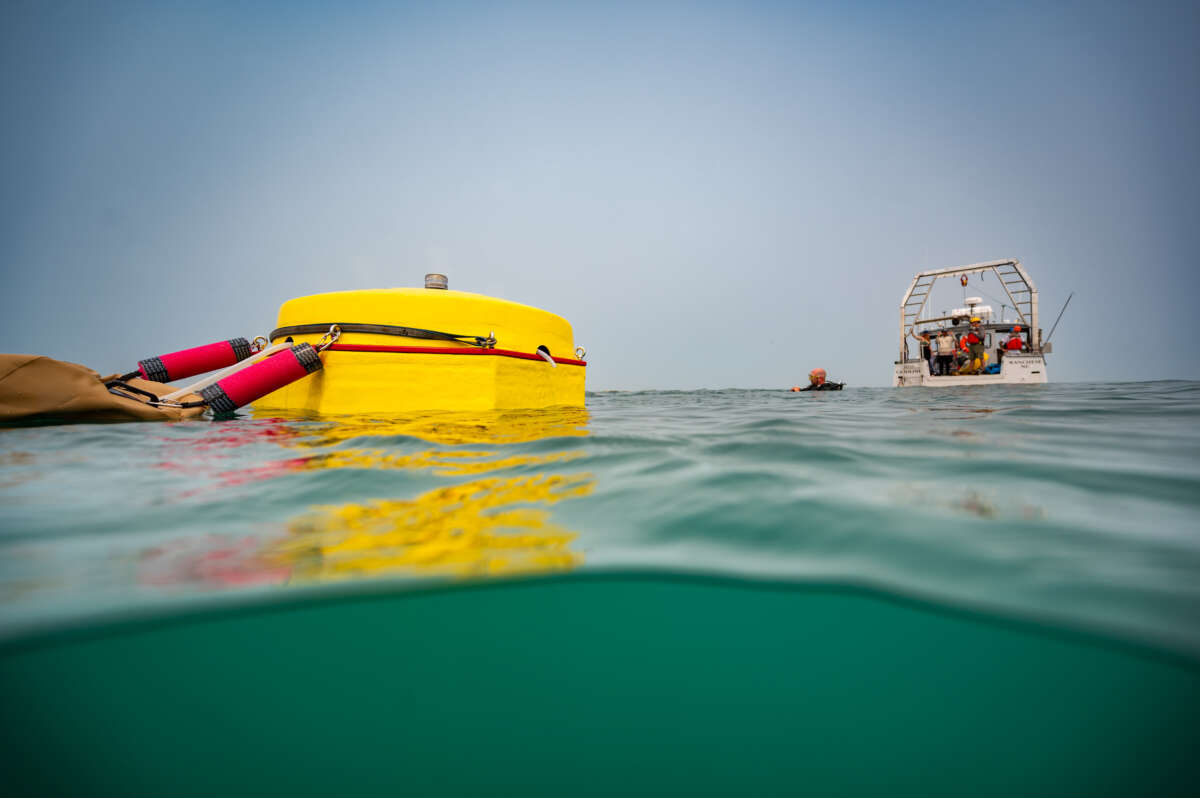
Like the WATER BROS device itself, the extensive partnership between CSI and the Water Bros team just gets better and better. Both parties value the relationship, not only for the strides made in research and development, but also for the technical aspects. Each has learned to communicate in lingo familiar to the other, resulting in seamless deployment and recovery missions. And if trouble does arise? Problem-solving is significantly less daunting because everyone is already on the same page.
“From design through deployment, CSI and WaterBros worked as one team to make sure this system was built and tested for the open ocean — and our three-tier testing campaign proved it, de-risking the system and preparing us for longer-duration deployments to come,” says Mackey.
“With this caliber of expertise and partnership in place, this was the most successful marine operation I’ve ever been part of, and it’s exactly the kind of collaboration the marine energy industry should be pointing to.”
When the logistics run like a well-oiled machine, even the loftiest of goals, like building community resilience through ocean energy, feel much more attainable.
The preceding story first appeared in the Summer 2026 edition of CoastLines, published in September. The ongoing WATERBROS research referenced in the article is made possible by the U.S. Department of Energy’s “Marine Energy Systems Innovation at Sea” Funding Opportunity (DE-FOA0002793). The project is formally known as “Long-duration testing and scalability of a lightweight, rapidly deployable, wave-powered reverse osmosis system” (DE-EE0010980).
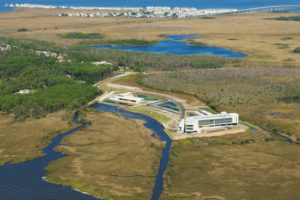 The ECU Outer Banks campus is home to the Coastal Studies Institute.
 Based at the Coastal Studies Institute (CSI), the North Carolina Renewable Ocean Energy Program (NCROEP) advances inter-disciplinary marine energy solutions across UNC System partner colleges of engineering at NC State University, UNC Charlotte, and NC A&T University. Click on the links below for more information.