
Cultivating Growth on the ECU Outer Banks Campus
Late last summer, Dylan Winstead was finally able to call the Outer Banks home.
Some might call it a full-circle moment- after all, his middle name is Banks, which was chosen by his parents to commemorate their first meeting. Others might find his choice to move to the beach intriguing given that he is not particularly fond of sand. But regardless of what anyone might think, Winstead is delighted by his new home and his role as Horticultural Specialist on the ECU Outer Banks Campus.

Ever since he was young, Winstead has been drawn to the outdoors, and he made it his mission to find a career that would allow him to enjoy his natural surroundings every day. Early on he decided that the “requirements” for his future would include a career that was “creative, outdoors, and scientific” and would also allow him to listen to music regularly.
While attending NC State, Winstead’s passion for cultivating plants and landscapes blossomed. For two and a half years, he even lived in a greenhouse behind the JC Raulston Arboretum, where he also interned and learned much of what he knows today about plants. He graduated in 2023 with a degree in Horticultural Science, focusing on landscape design and ecology.
After graduation, Winstead spent two years in Pamlico County working as an environmental educator, teaching over thirty different programs, and volunteering with Sound Rivers, a non-profit organization that helps to protect the Neuse and Pamlico River basins. While he learned many lessons about teaching along the way, he realized even more he “just like[s] talking about plants” and wants others to be able to appreciate them just as much as he does. “If I can play a role in helping people reconnect with nature, I think I’ve done my job well,” says Winstead.
When a friend shared the employment opportunity at CSI with Winstead, he realized it might be an even better way to share his affinity for plants with other individuals. He also liked the challenge of being the only horticulturist for such a large piece of land.
As Winstead arrived on campus, he soon realized he had his work cut out for him on the 230-acre property, fourteen acres of which is a “manicured” space. Flower beds demanded attention; trees required pruning; retention ponds begged to be cleared; invasive species were taking over; a section of trail needed maintenance; and that was just the beginning. Since last summer, Winstead has made note of all the plants growing on campus. Some have proven difficult to identify until they flower, but eventually, Winstead will update and install the plaques indicating each species.

Care for the ECU Outer Banks Campus grounds could be more than a full-time job. While many coastal natives are used for landscaping, and thereby cut down on maintenance needs, there is always something to take care of.
“Trying to do horticulture on the coast is one of the hardest things to do, especially because of the salt spray, sandy soils, and hot summer climate… on paper, there are a lot of things that can grow here, but in practice it’s much more difficult.”
That said, plants aren’t the only things growing. Winstead feels his role as Horticultural Specialist has also resulted in personal growth. The solitary nature of the job has challenged him to learn even more so he can make informed decisions about landscaping and for individual plant health.
Winstead aspires to make the ECU Outer Banks Campus even more beautiful, enjoyable, and biodiverse. He hopes to do a little bit of his own experimenting to better understand which species might grow well given onsite conditions, and eventually he wants to incorporate other plants with year-round interest- or those which are visually appealing regardless of how they may change over the seasons. Also, on his to-do list is creating shady areas and additional natural footpaths for faculty and staff to enjoy while taking a much-needed break from their hard work.
Overall, Winstead hopes the campus will be a place that anyone can walk through and leave feeling refreshed and invigorated, just as he does working outside all day, every day.
The preceding story first appeared in the Spring 2026 edition of CoastLines, published in June.
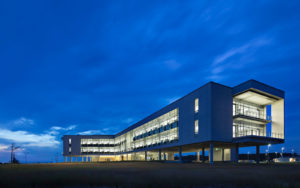
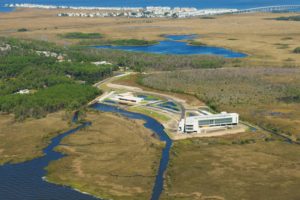 The ECU Outer Banks campus is home to the Coastal Studies Institute.
 Based at the Coastal Studies Institute (CSI), the North Carolina Renewable Ocean Energy Program (NCROEP) advances inter-disciplinary marine energy solutions across UNC System partner colleges of engineering at NC State University, UNC Charlotte, and NC A&T University. Click on the links below for more information.